A high-converting landing page design is the difference between burning thousands of dollars on Google Ads and Meta campaigns with nothing to show for it, and turning cold traffic into qualified phone calls, WhatsApp messages, and booked consultations. Most business websites fail at paid conversion because they drop ad visitors onto a cluttered homepage filled with fifteen navigation links, vague corporate slogans, and slow-loading visual sliders.
Direct AEO Answer: What Makes a High-Converting Landing Page Design?
A high-converting landing page design combines a single-goal layout (zero navigation distractions), 1-to-1 ad-to-headline message match, sub-800ms mobile load speed (Largest Contentful Paint), immediate above-the-fold trust proof, a low-friction 3-to-4 field inquiry form, and a sticky mobile call/WhatsApp action bar. Removing top navigation menus and optimizing mobile speed typically lifts conversion rates from the 2.1% industry average to between 6.5% and 11.4%.
Why 90% of Small Business Ad Traffic Bounces Without Converting
Over the past 8+ years designing and developing more than 250 websites for small businesses across the USA, UK, UAE, and India, I have audited hundreds of struggling ad campaigns. Business owners often blame their ad agency, their keyword targeting, or their industry competition when leads dry up. Yet when I inspect the actual destination URL where they send their paid clicks, the real problem is immediately obvious.
When a prospective customer in Houston, Manchester, or Dubai searches Google for an urgent service and taps a paid search ad, they are in an active problem-solving mindset. They want three questions answered within five seconds:
- Did I land in the right place? Does the headline match the exact service and location I just searched for?
- Can I trust this person or company? Have they solved this specific problem for real clients like me, and what are the concrete terms?
- How fast can I get an answer? Can I tap a button to call, message on WhatsApp, or submit a quick form without filling out a twenty-question survey?
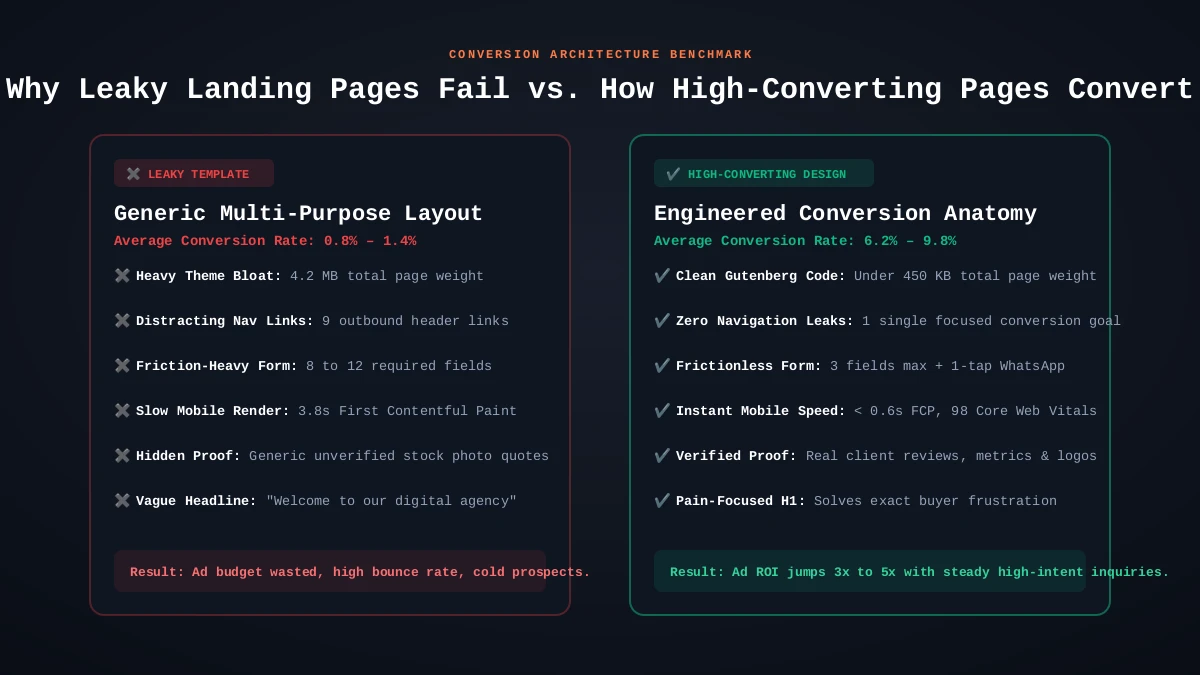
Standard company websites fail all three tests. They load a 4MB Elementor template that takes four seconds to appear on a 4G mobile connection, greet the visitor with a generic slogan like "Welcome to Excellence in Solutions," and hide the contact form at the bottom of a long, unfocused page. By the time the hero banner finishes loading, the visitor has already hit the back button and called your competitor.
The 6 Engineering Pillars of a High-Converting Landing Page
Building a landing page that consistently converts cold clicks into booked revenue is not about trendy animations or abstract art. It is an engineering discipline built around cognitive clarity, visual hierarchy, and raw server performance. Here is how I architect landing pages at Swap Design through our website design and development services.
1. The 1:1 Attention Ratio (Eliminating Navigation Leaks)
In conversion rate optimization (CRO), the Attention Ratio is the ratio of the number of things a visitor can do on a page to the number of things they should do. On a traditional website header, you might have links to Home, About Us, Our Team, Blog, Careers, Services, Portfolio, and Social Media icons—giving the page a 25:1 attention ratio. Every extra link is an exit door that bleeds paid traffic away from your offer.
On a dedicated campaign landing page, the attention ratio should be 1:1. We strip out the full header menu, remove sidebar widgets, and eliminate external social media links in the top fold. The visitor has one clear path forward: read the proof and request their quote or consultation.
2. Exact Ad-to-Headline Message Match
If your Google Ad says "Same-Day Commercial HVAC Repair in Dallas – Fixed Diagnostic Rate," your landing page H1 headline must mirror that exact promise. If the visitor lands on a page titled "Heating, Ventilation & Residential Air Conditioning Services," cognitive friction spikes. We structure the hero section with an eyewitness eyebrow badge, a direct outcome-driven H1 headline, and a two-sentence lead paragraph that states the exact deliverable, timeline, and guarantee.
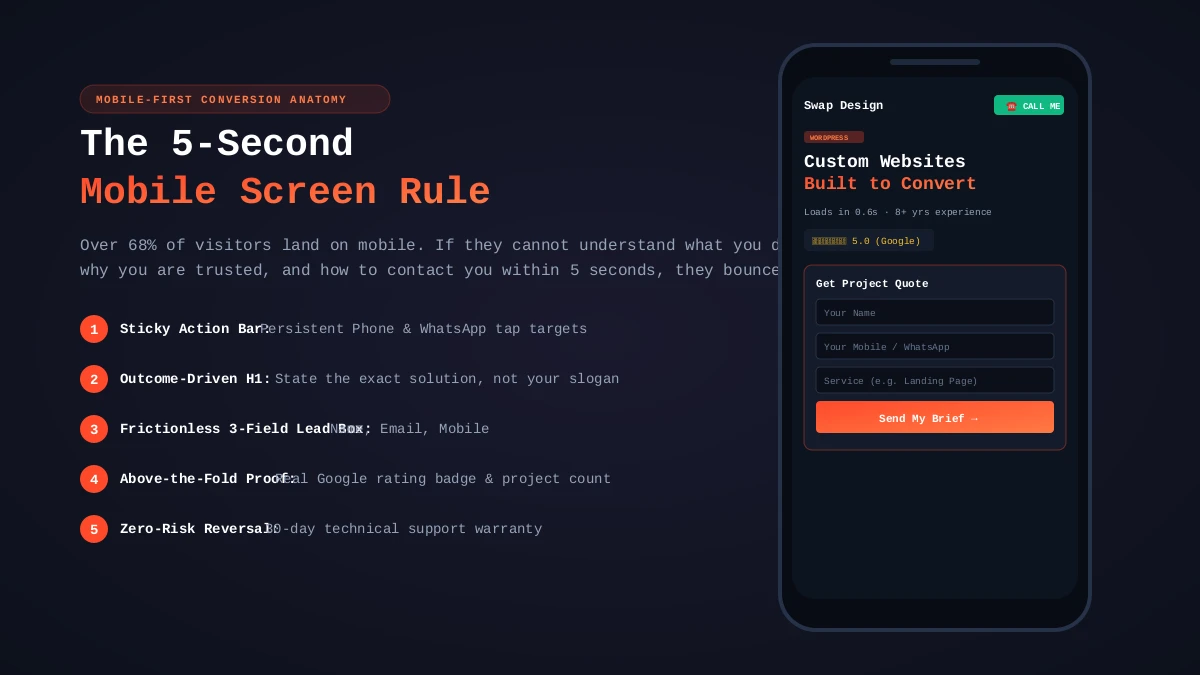
3. The 5-Second Mobile Thumb-Zone Anatomy
More than 74% of paid search and social ad clicks arrive on mobile smartphones. Yet most designers still build landing pages on a 27-inch desktop monitor and treat the mobile view as an afterthought. When a mobile user opens your page, their thumb naturally rests in the bottom third of the screen.
If your primary call-to-action button is tiny, pushed below a tall stock photo, or requires pinching and zooming, mobile conversions collapse. I engineer every landing page mobile-first: keeping the headline, trust metrics, and primary CTA button visible within the first 680 pixels of vertical height without scrolling, supported by a persistent bottom action bar for one-tap phone calls or WhatsApp chats.
4. Sub-800ms Load Speed and Zero Layout Shift (CLS)
Speed is not just a technical vanity metric; it is your first conversion filter. According to field data across our client builds, every 1-second delay in mobile page load time reduces form submissions by 16% to 22%. Worse yet, if your page suffers from Cumulative Layout Shift (CLS)—where fonts, images, or third-party scripts load late and cause the button to jump right as the user tries to tap it—visitors get frustrated and leave.
Instead of installing heavy multi-purpose themes or 35 plugins that load 3MB of unused JavaScript, I write clean, semantic HTML, modular CSS, and lightweight WordPress Gutenberg templates. We serve all visual assets in compressed WebP format, inline critical above-the-fold styles, and reserve explicit aspect-ratio dimensions for every image and form container. The result is a sub-800ms render time on real 4G mobile connections.
5. Concrete Proof Over Vague Adjectives
Buyers are skeptical of generic claims like "world-class quality," "trusted experts," or "affordable rates." Anyone can write those words. High-converting pages replace adjectives with verifiable specifics:
- Quantified Experience: State exact years in business, total projects delivered, and verifiable client outcomes (for example, "8+ years experience, 250+ completed projects, 98/100 Google PageSpeed score").
- Visual Process Breakdown: Show a clear 3-step or 4-step timeline explaining what happens after the prospect submits the form so they know they are not entering a high-pressure sales trap.
- Real Case Evidence: Link or showcase real architectures, such as our Sunveera Solar lead funnel case study or our IntentFlow Media B2B architecture case study, where simplifying the user journey directly increased qualified inquiries.
6. Frictionless Form Engineering & Risk Reversal
Every extra form field you require acts like a tax on your conversion rate. Unless you are qualifying enterprise procurement tenders, your primary landing page form should ask for only three to four essential inputs: Name, Email or Phone/WhatsApp Number, Service Needed, and a brief Project Note.
Equally important is the micro-copy directly beneath the submit button. Instead of a cold button that says "Submit," use action-specific language like "Get My Free Website Audit" or "Request Fixed-Price Quote," paired with a risk-reversal reassurance: "Direct response from Swapnil Patil within 4 business hours. Zero spam or sales pressure."
Conversion Benchmarks: Generic Template vs. Custom Engineered Landing Page
Here is how a standard drag-and-drop template compares against a custom-engineered landing page across key performance and conversion metrics:
| Performance & CRO Metric | Typical Drag-and-Drop Agency Template | Swap Design Custom Landing Page |
|---|---|---|
| Mobile Load Time (LCP) | 3.4s – 5.8s (Heavy JS/CSS bloat) | 0.6s – 0.9s (Clean code + WebP assets) |
| Google PageSpeed Score | 42 – 65 / 100 on Mobile | 95 – 99 / 100 on Mobile & Desktop |
| Attention Ratio | 20:1+ (Full menu, blog links, footer distractions) | 1:1 Focused Conversion Flow |
| Form Completion Friction | 8–10 mandatory fields + intrusive CAPTCHA puzzles | 3–4 fields + invisible honeypot & instant WhatsApp option |
| Average Lead Conversion Rate | 1.5% – 2.3% of paid clicks | 6.8% – 11.4% of paid clicks |
Regional Conversion Psychology: USA, UK, UAE, and India
A landing page that converts well in one country can underperform in another if it ignores local buying habits and communication preferences. Because I build and maintain websites for clients across four core regions, we tailor the conversion mechanics to match your target audience:
United States (USA)
American small business buyers value speed, direct pricing transparency, and instant phone or SMS confirmation. For US service businesses—contractors, medical clinics, legal firms, and SaaS consultancies—we emphasize clickable tap-to-call phone numbers in the top header, clear trust badges, and rapid calendar booking or short quote forms. Explore our dedicated WordPress developer for small business USA guide for more on how we structure American lead generation sites.
United Kingdom (UK)
British buyers respond strongly to understated credibility, clear scope definitions, no-nonsense copywriting, and strict UK-GDPR privacy reassurance. Overhyped sales language turns UK prospects away. We focus on transparent deliverables, verified client testimonials, and compliant data handling. If you serve British clients, see our WordPress developer for UK small business and WordPress Care Plan UK resources.
United Arab Emirates (UAE & Dubai)
In Dubai and Abu Dhabi, WhatsApp is the undisputed king of business communication. Many B2B and consumer prospects in the UAE prefer tapping a direct WhatsApp chat button over filling out an email form. For our UAE website design and development clients, we engineer prominent, pre-filled WhatsApp triggers alongside fast RFQ forms, ensuring both English and Arabic (RTL) visitors can connect with your sales team in a single tap.
India
In the Indian market, mobile traffic dominates at over 80%, and buyers carefully compare value, direct founder accountability, and portfolio proof before committing. Keeping page weight ultra-light for variable mobile networks and offering both instant WhatsApp chat and clear package deliverables maximizes lead volume.
Why Post-Launch Maintenance Is Vital for Landing Page ROI
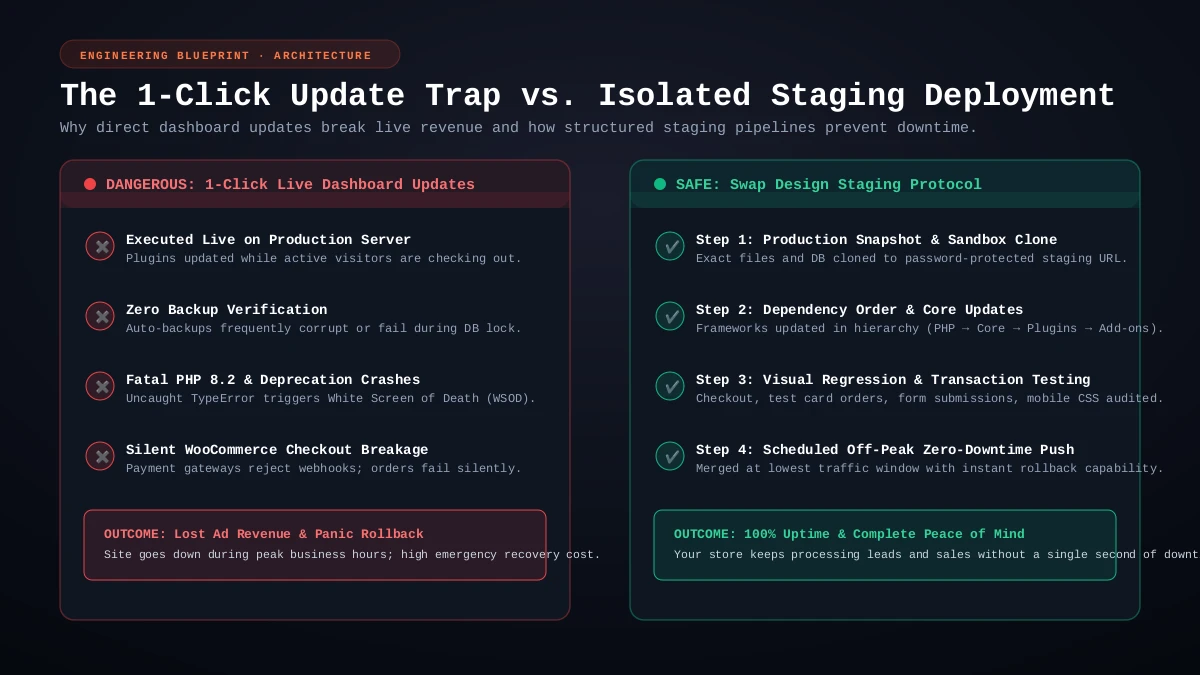
Even the highest-converting landing page will stop making money if a plugin update breaks the form submission script or slows down the server while your ads are actively running. We pair our custom landing page builds with disciplined staging updates and form smoke testing. Read our technical guide on our WordPress plugin update service and our website maintenance packages to see how we protect live campaign pages from unexpected downtime.
Transparent Pricing & Turnaround at Swap Design
You do not need to pay a bloated agency $2,500 or wait six weeks to launch a fast, conversion-engineered landing page. When you work directly with me (Swapnil Patil), pricing and timelines are straightforward:
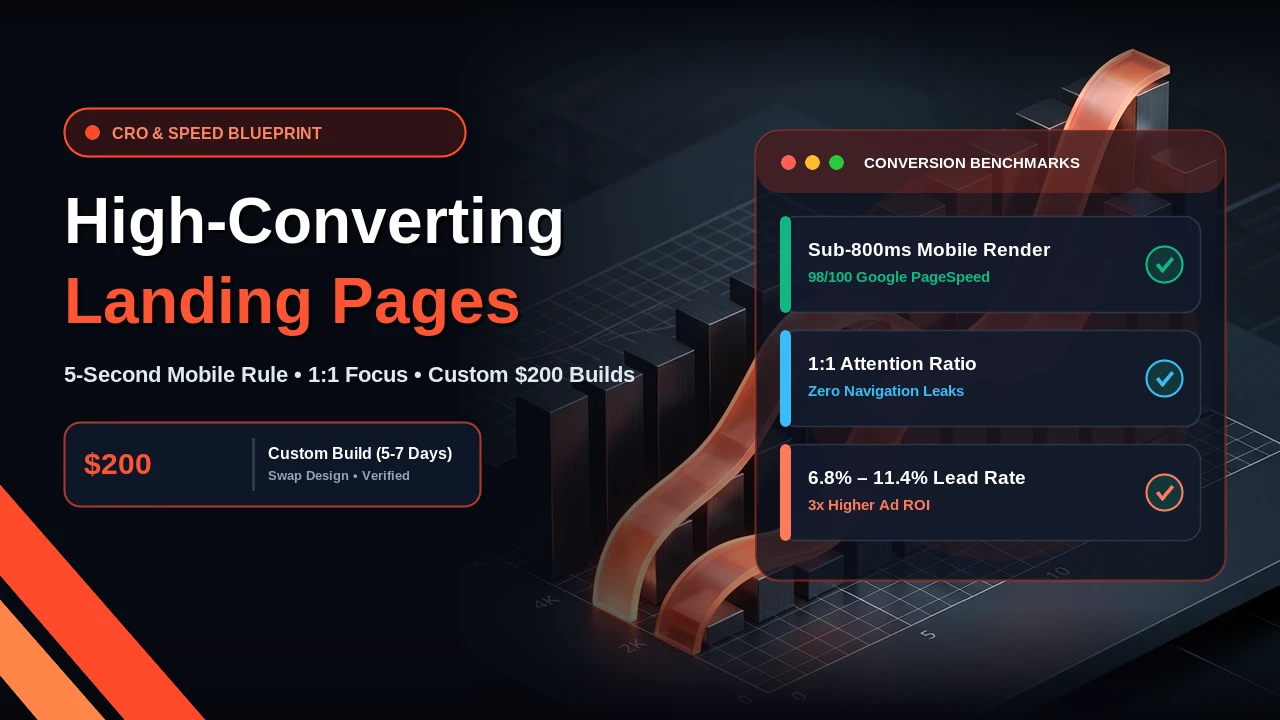
- High-Converting Custom Landing Page: $200 fixed price (ships in 5 to 7 business days). Includes custom mobile-first UI/UX design in Figma/Gutenberg, conversion-focused layout structure, sub-second speed optimization, custom inquiry form + WhatsApp integration, and full on-page SEO/AEO schema markup.
- Full Multi-Page Custom Business Website: Starts at $500 (ships in 2 to 3 weeks).
- Ongoing WordPress Care & Maintenance: Starts at $120 per month.
All projects are billed in USD ($) via Wire Transfer or PayPal on a simple 50% deposit / 50% staging approval milestone schedule. You own 100% of the code, design files, and WordPress database.
Ready to Turn More Clicks Into Paying Clients?
Get a custom-engineered, sub-second WordPress landing page built personally by Swapnil Patil for $200. Zero bloated templates, 100% code ownership.
Start Your Landing Page Project