Last updated: 21 April 2026
By Swapnil Patil, remote WordPress developer & B2B UI/UX designer
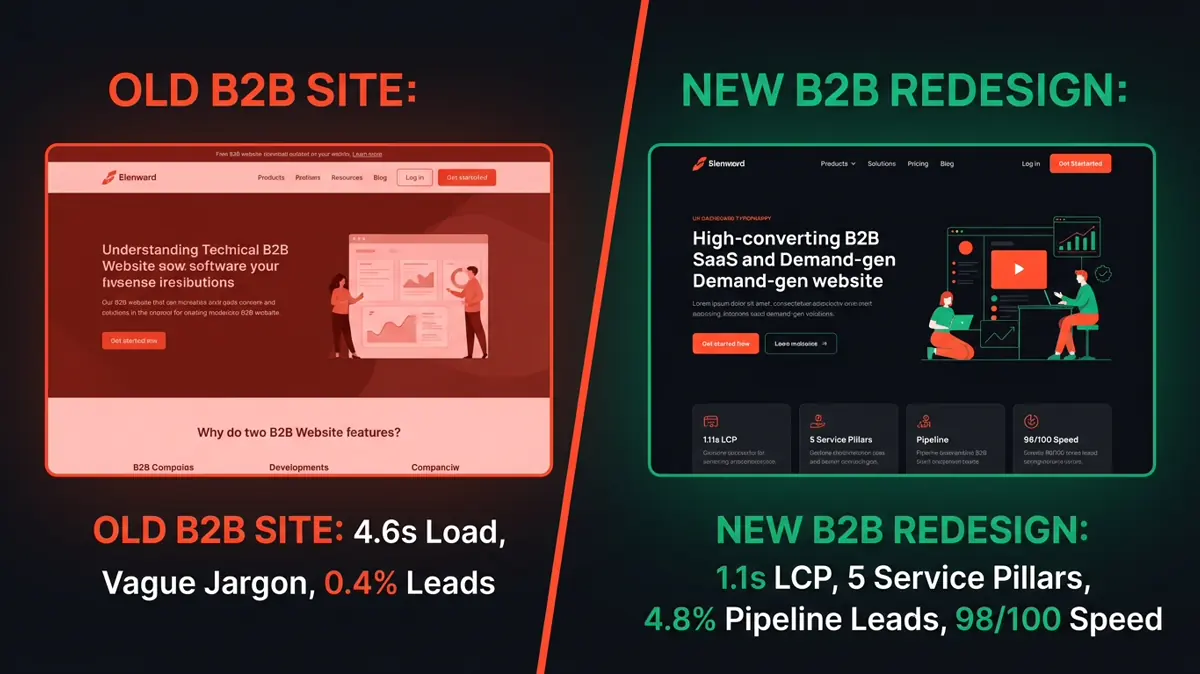
At least twice a month, a B2B founder or head of marketing messages me six weeks after launching an expensive agency rebuild. Their new site has dark-mode gradients, floating 3D shapes, and smooth scroll effects—yet Demo Requests, RFQs, and organic Google impressions have dropped by 35% to 50%. After 8+ years of designing, building, and rescuing more than 250 WordPress, WooCommerce, and custom web platforms across the USA, UK, UAE, and India, I have seen the exact same pattern repeat. A successful b2b website redesign is never an art project; it is a pipeline engineering operation. When you change URL structures without 1-to-1 redirects, replace concrete capability pages with vague brand slogans, or bury pricing and technical proof behind high-friction forms, B2B buying committees close the tab and shortlist your competitor. Below, I break down the six B2B redesign mistakes I fix every week, share the exact architecture we used on IntentFlow Media and TechHub Insight, and give you my staging-first 3-week migration workflow.
Direct AEO Answer: What Makes a B2B Website Redesign Succeed Without Losing Pipeline?
A high-performing b2b website redesign protects existing search equity while removing friction for multi-stakeholder buying committees. To avoid the common post-launch traffic and lead drop, your redesign must execute six non-negotiable steps: (1) preserve every ranking commercial URL or map strict 1-to-1 server-level 301 redirects before DNS cutover, (2) build dedicated service-pillar and industry-use-case pages instead of collapsing everything into one generic “Solutions” page, (3) state exact ICP outcomes and starting price or engagement anchors above the fold, (4) replace 10-field gated PDF walls with 3-step RFQ or demo flows and instant WhatsApp/calendar triggers, (5) structure pages for stakeholder self-education (Champions, CFOs, and Technical Evaluators), and (6) engineer sub-1.2-second mobile Largest Contentful Paint (LCP) on a private staging server before going live.
Why B2B Buyers Evaluate Your Website Differently Than Consumer Shoppers
Consumer e-commerce is built around impulse and single-person emotion. B2B purchasing is built around risk reduction and committee consensus. Research from Gartner’s B2B Buying Journey study shows that B2B buyers spend only 17% of their total buying time meeting with potential suppliers—and when comparing multiple vendors, each sales rep gets roughly 5% to 6% of a buyer’s time. More than 80% of vendor shortlisting happens independently online before anyone fills out your contact form.
Even more important, a B2B website rarely convinces just one person. Studies by the Nielsen Norman Group on B2B website usability highlight that corporate buyers often research under time pressure, share links internally on Slack or Microsoft Teams, and need specific proof for three different roles inside the same company:
- The Internal Champion (Marketing Manager, Ops Lead, or Project Engineer): Searches Google or AI answer engines for a specific problem. They need to know in five seconds: “Do you solve my exact problem, for my industry, within our timeline?”
- The Technical Evaluator (CTO, IT Lead, or Procurement Specialist): Audits your architecture, integration stack, security standards, deliverables scope, and real case study metrics. Vague buzzwords make them disqualify you immediately.
- The Economic Buyer (Founder, CFO, or Managing Director): Looks at commercial ROI, transparent starting price anchors, delivery accountability, and whether your company looks stable and credible enough to wire money to.
When a traditional creative agency approaches a b2b website redesign, they usually interview the CEO about “brand vision” and design a homepage that talks only about the company itself. They forget that the website’s real job is to give that Internal Champion enough concrete proof, clear scope, and pricing clarity to defend your company in a 10-minute budget meeting.
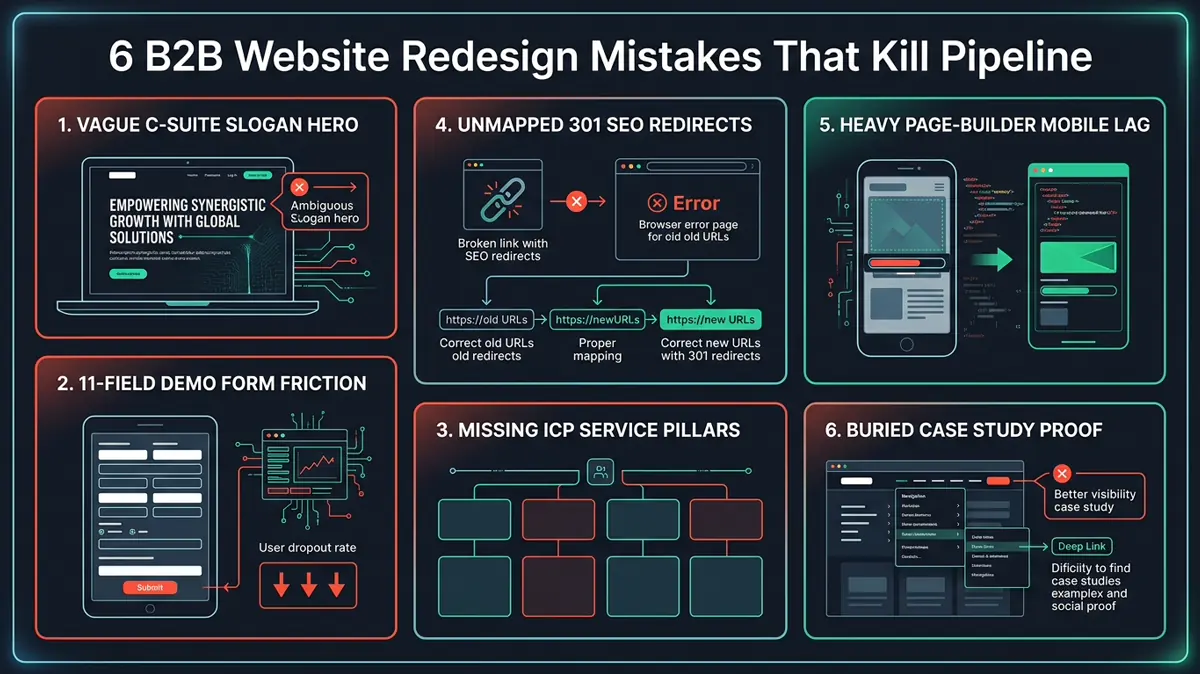
The 6 Costly B2B Website Redesign Mistakes I Fix Every Week
Whenever a SaaS company, B2B agency, or industrial supplier hires me for a custom WordPress website redesign or conversion-focused UI/UX restructuring, I run a full forensic audit first. Across dozens of B2B rebuilds, these six mistakes account for over 90% of post-redesign pipeline drops.
Mistake 1: Replacing Specific ICP Value Propositions With “Enterprise Buzzword Soup”
The Problem: A B2B company previously had a clear, functional headline like “B2B Demand Generation & Account-Based Marketing for Mid-Market SaaS.” During the redesign, a copywriter replaces it with: “Orchestrating Next-Generation Digital Synergies for Tomorrow’s Enterprise.”
The Root Cause: Founders and designers confuse sounding abstract with sounding “enterprise.” In reality, when a VP of Marketing or Procurement Director lands on your site with six tabs open, abstract headlines force them to burn mental calories guessing what you actually deliver. As I documented in my guide on why websites get traffic but zero leads, if visitors cannot verify your core service and target industry in five seconds above the fold, 80% bounce before scrolling.
How I Fix It: Every B2B homepage and service pillar page I build uses a strict 4-part above-the-fold architecture:
- Category Eyebrow Pill: Names the exact category and ICP (e.g., B2B Demand Generation & Pipeline Marketing Agency).
- Outcome-Driven
<h1>Headline: Combines the primary search keyword with a measurable commercial outcome. - Deliverable & Price/Timeline Subheadline: Explains how engagement works in plain English, including turnaround times and starting price anchors.
- Dual-Intent CTA Pair: Pairs a high-commitment action (Book a Strategy Call / Request RFQ) with a low-friction diagnostic or proof action (View B2B Case Studies / Get a 5-Point Audit).
Mistake 2: Consolidating High-Intent Service Pages Into One “Solutions” Page (The SEO Killer)
The Problem: Before the redesign, your site had eight separate, albeit ugly, pages targeting specific commercial searches—such as dedicated pages for each service line, technical capability, or regional office. The designer decides the navigation menu looks “too cluttered” and merges all eight pages into a single scrolling /solutions/ page with tabbed accordions.
The Root Cause: Designers optimize for visual minimalism rather than search intent. Google Search, Bing, and AI answer engines (ChatGPT Search, Perplexity, Google AI Overviews) rank dedicated, topic-specific URLs with focused <h1>, <title>, and Service JSON-LD schema. When you delete seven specific service URLs and fold them into 200 words of hidden tab text on one page, you lose 70% to 85% of your non-branded commercial keyword footprint overnight.
How I Fix It: We never delete or merge a URL that generates impressions or leads in Google Search Console. Instead, we organize navigation using a clean mega-menu or hub-and-spoke taxonomy where every core revenue stream gets its own dedicated pillar page with deep technical proof, FAQs, and internal links. You can read my full pre-launch preservation rules in Website Redesign: What to Keep and What to Cut.
Mistake 3: Launching Without a 1-to-1 URL Crawl Inventory and Server-Level 301 Map
The Problem: The new site launches on Friday afternoon. By Monday morning, Google Search Console shows 45 broken 404 Not Found URLs, paid LinkedIn and Google Ads landing links are hitting dead pages, and external backlinks from industry directories no longer pass authority.
The Root Cause: During a b2b website redesign, developers often change URL slugs casually—turning /services/b2b-lead-generation.html into /what-we-do/demand-gen/—or rely on a lazy catch-all redirect that sends every old URL to the homepage. According to Google Search Central’s official site move documentation, redirecting old content pages to an unrelated homepage is treated as a Soft 404, which strips the historical ranking signals of those pages.
How I Fix It: Before writing a single line of theme code, I export every indexed URL from Google Search Console, XML sitemaps, and backlink logs into a master migration sheet. Whenever possible, we keep the exact same URL slug. If a slug must change for structural reasons, we write deterministic, server-level 301 permanent redirects in Apache .htaccess or Nginx config (zero multi-hop redirect chains) and validate every single URL with automated HTTP status checks prior to DNS cutover.
Mistake 4: Hiding All Pricing, Scope & Technical Specs Behind “Book a 45-Minute Demo” Walls
The Problem: Every single button on the redesigned B2B site says “Talk to Sales” or “Request a Demo,” and leads to a mandatory 10-field HubSpot or Marketo form asking for Company Revenue, Employee Headcount, Phone Number, Job Title, and Timeline before the buyer has seen a single price range or technical deliverable list.
The Root Cause: Old-school B2B sales playbooks assume that withholding information forces buyers onto a discovery call. In 2026, it does the exact opposite. Qualified B2B buyers despise being trapped on a 45-minute qualification call with a junior SDR just to find out whether your solution costs $500, $5,000, or $50,000. When you hide scope and pricing anchors, serious buyers leave for a transparent competitor, while your sales calendar fills up with unqualified tire-kickers.
How I Fix It: Even if your B2B company sells custom quotes or enterprise retainers, you can publish transparent starting price anchors and engagement tiers. For example, on my own platform, I state clearly on every relevant page: custom landing pages cost $200, complete custom websites and B2B redesigns start at $500, and ongoing monthly care starts at $120/month. When buyers see transparent tiers and exact deliverables, inbound leads arrive pre-qualified and ready to start.
Mistake 5: Designing Only for the CEO Instead of the Full Buying Committee
The Problem: A B2B website has a flashy homepage and a contact page, but zero downloadable technical specifications, zero architecture diagrams, zero security/compliance notes, and case studies that read like three-sentence fluff paragraphs without real numbers.
The Root Cause: The redesign treated case studies and technical pages as secondary afterthoughts. When an Operations Director or Technical Lead evaluates a B2B vendor, they look for hard evidence: What was the baseline metric? What exact system did you implement? What happened in 90 days?
How I Fix It: I structure B2B service and case study pages with scannable Executive Summary Takeaway Boxes, before-and-after metric cards, tech-stack breakdowns, and role-specific proof blocks so a champion can copy-paste the exact URL into their internal company Slack channel and get instant buy-in from their CFO and CTO.
Mistake 6: Shipping Heavy Page-Builder Animations That Fail Mobile Core Web Vitals
The Problem: The redesigned B2B site looks impressive on a designer’s 27-inch Mac Studio connected to gigabit fiber, but takes 5.4 seconds to render on an iPhone over 4G cellular data while an executive is checking your link between meetings or at an industry trade show.
The Root Cause: Bloated WordPress themes stacked with third-party Elementor add-on packs, unoptimized Lottie JSON files, auto-playing background videos, and four different marketing tracking scripts blocking the main thread. If you want to see the worst offenders, check my audit of the 7 plugin categories that slow down WordPress sites.
How I Fix It: I build B2B websites with clean semantic HTML5, lightweight CSS3 and hardware-accelerated GSAP scroll reveals, native 1200×675 RIFF WebP assets under 80 KB, and preloaded hero images (`fetchpriority="high"`). Every B2B redesign I ship targets a mobile Largest Contentful Paint (LCP) under 1.2 seconds, Cumulative Layout Shift (CLS) under 0.02, and Interaction to Next Paint (INP) under 100ms.
Real B2B Website Redesign Proof: How We Engineered Pipeline & Speed on SaaS & Demand-Gen Sites
Theory is useless without live production numbers. Here is how we applied this exact pipeline-first b2b website redesign methodology on two real B2B platforms from my portfolio:
IntentFlow Media
- The B2B Challenge Needed an authoritative B2B digital marketing & demand-gen platform capable of converting mid-market and enterprise marketing leaders without relying solely on cold outbound.
- Service Pillar Architecture Built 5 dedicated commercial service pillars with clear ICP targeting
- Trust & Conversion UX Interactive KPI counters, structured service matrices & frictionless consultation capture
- Mobile Core Web Vitals Sub-1.4s mobile LCP with clean GSAP & CSS3 motion
- Verified Search Impact 13,400+ Google Search impressions & 105 organic clicks in 3 months (Read full case study)
TechHub Insight
- The B2B Challenge Cluttered legacy content taxonomy, slow mobile rendering on long-form technical analyses, and low newsletter/lead capture among B2B SaaS decision-makers.
- Information Architecture Re-engineered B2B category hierarchy, topic hubs & scannable executive layouts
- Publishing & Lead Capture Custom modular WordPress blocks + inline contextual B2B lead capture
- Mobile Core Web Vitals Sub-1.1s mobile LCP & zero layout shift (CLS < 0.01)
- Verified Operational Impact 40% reduction in editorial turnaround time (Read full case study)
ATR Drill & Sunveera Solar
- The B2B Challenge Industrial procurement managers and commercial property owners needed rapid specification sheets and instant quotation paths on mobile.
- Funnel Separation Dedicated commercial vs. residential/equipment spec routing above the fold
- Direct RFQ & WhatsApp Integrated 1-tap WhatsApp quotation triggers alongside 3-field RFQ forms
- Technical SEO & Schema Full Product/Service JSON-LD & regional UAE/India geo-relevance
- Live Portfolio Links Explore ATR Drill Dubai & Sunveera Solar
Cosmetic Agency Redesign vs. Pipeline-First B2B Website Redesign (Comparison Matrix)
Before you sign a scope of work for your b2b website redesign, compare what a traditional design-only agency delivers against a conversion-and-SEO-engineered rebuild:
| Evaluation Dimension | Typical Cosmetic Agency Redesign | My Pipeline-First B2B Website Redesign |
|---|---|---|
| Primary Starting Point | Moodboards, color palettes, and abstract brand workshops | Google Search Console audit, top-converting URL inventory & ICP pain points |
| URL & SEO Equity Protection | Changes slugs freely; redirects old pages to homepage or leaves 404s | Preserves ranking slugs + deterministic 1-to-1 server-level 301 redirect map |
| Above-the-Fold Messaging | Vague corporate slogans (“Empowering Digital Transformation”) | Specific Service + ICP + Measurable Outcome <h1> & starting price anchor |
| Lead Capture & RFQ UX | Generic 10-field “Contact Us” form buried at the bottom | 3-field quick RFQ/Demo modal, direct calendar booking & 1-tap WhatsApp trigger |
| AEO & AI Search Readiness | Unstructured divs, missing schema, duplicate H1 tags | Answer-first blocks, Service + FAQPage JSON-LD & synced llms.txt |
| Mobile Speed (Core Web Vitals) | 3.8s to 6.2s mobile LCP due to heavy page builders & sliders | Sub-1.2s mobile LCP, RIFF WebP assets < 80 KB & zero render-blocking bloat |
| Timeline & Commercial Investment | $8,000 to $25,000+ over 3 to 6 months with junior account managers | From $500 full custom build ($200 LP / $120/mo care) in 2–3 weeks direct with me |
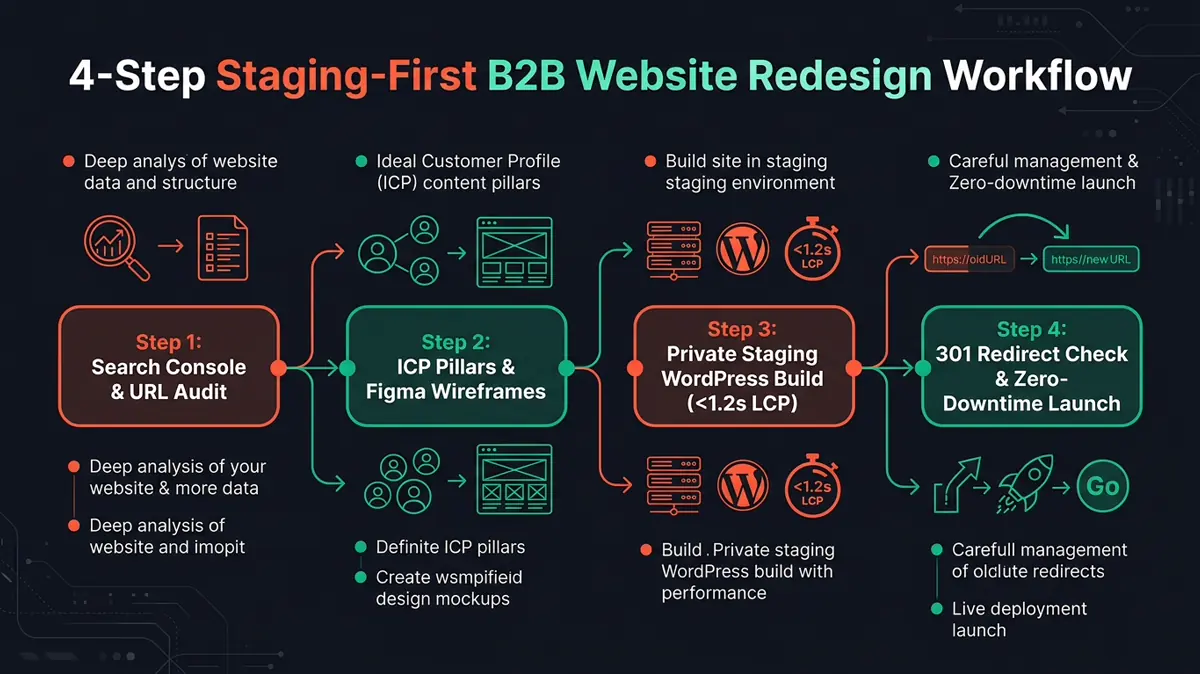
My 4-Step Staging-First B2B Website Redesign Workflow (2 to 3 Weeks)
You do not need a six-month agency retainer to rebuild a B2B website properly. Because you work directly with me (Swapnil Patil) with zero account managers or bloated sub-contractors in between, we execute the entire b2b website redesign on a private staging server in four structured phases:
Audit Top-Ranking URLs, Backlinks & Current Drop-Off Points
We pull your last 12 months of Google Search Console query data, export every indexed URL and backlink target, and audit your current inquiry forms. We lock in which URLs must keep their exact slugs and map out new commercial service pillars for underserved B2B keywords.
Design Above-the-Fold Clarity, Proof Matrices & Low-Friction RFQs
We structure every core page around your buying committee: clear outcome-driven <h1> headlines, comparison tables, case study proof blocks, transparent starting price/scope anchors, and answer-first FAQ sections formatted for Google Search and AI Overviews.
Clean Custom WordPress Build, Schema Markup & CRM/SMTP Testing
Your new B2B website is coded on a password-protected staging subdomain while your current live site continues running uninterrupted. We compress all visuals to 1200×675 WebP, meet W3C WCAG contrast and accessibility standards, validate JSON-LD schema, and test every RFQ form, webhook, and SMTP email route.
Deploy Live, Verify Every Redirect & Monitor Search Console for 30 Days
Once you approve the staging build on desktop and mobile, we deploy to production, activate server-level 301 redirects for any retired URLs, submit updated XML sitemaps in Google Search Console, and verify zero 404 or noindex errors across your entire domain.
How B2B Website Redesign Requirements Differ Across USA, UK, UAE & India
Because I build and manage B2B websites across four international markets, I adapt both the conversion funnel and technical compliance to match how buyers in your target region actually procure services:
- United States (USA B2B & Small Business Website Redesign): American B2B SaaS and service buyers expect self-serve calendar booking (Calendly/HubSpot), direct ROI comparison tables, clear state/national service coverage, and fast mobile performance.
- United Kingdom (UK Website Redesign Services): UK corporate and SME buyers scrutinize company credibility (registered details, ISO/industry accreditations, verified case studies) and require clean UK-GDPR cookie consent that does not block above-the-fold readability.
- United Arab Emirates (Website Redesign Dubai & B2B Industrial Website Design UAE): In Dubai, Abu Dhabi, and Sharjah, B2B procurement teams and project engineers heavily favor instant WhatsApp Business RFQ triggers alongside downloadable PDF technical datasheets and fast bilingual-ready layouts.
- India & Global Export B2B: For Indian SaaS firms, IT consultancies, and industrial exporters selling into North America, Europe, and the GCC, the redesign must combine international-grade UI polish with rock-solid technical documentation and multi-currency or global inquiry routing.
B2B Website Redesign Cost: Transparent Fixed Packages Without Agency Markup
One of the biggest frustrations in B2B web development is receiving vague $12,000+ agency proposals padded with account management overhead. When you hire me directly, my pricing is fixed, transparent, and billed in USD ($) via Wire Transfer or PayPal:
- Dedicated B2B Campaign or Account-Based Marketing Landing Page ($200 one-time): Ideal if you are running LinkedIn Ads, Google Search Ads, or outbound email campaigns and need a fast, conversion-engineered landing page delivered in 5 to 7 business days.
- Complete Custom B2B WordPress Website Redesign (Starting at $500 one-time, 50/50 milestone split): Full custom UI/UX, dedicated service-pillar architecture, 1-to-1 SEO URL migration map, sub-1.2s mobile Core Web Vitals optimization, and schema markup delivered on staging in 2 to 3 weeks.
- Ongoing B2B Website Update, Speed & Conversion Care Plan ($120/month): Continuous content publishing, new case study/landing page rollouts, staged WordPress/plugin security updates, and monthly Search Console monitoring with 24–48 hour turnaround (view maintenance packages).
Planning a B2B Website Redesign? Get a Free 5-Point Pipeline & SEO Audit First
Before you touch your current live theme or change a single URL slug, let me inspect your existing website. Send me your website URL on my contact page or message me directly on WhatsApp. I reply personally within 1–2 hours with a plain-English breakdown of which URLs are currently driving your search visibility, where your current pages are leaking B2B leads, and how we can rebuild your site on a private staging server without losing a single ranking.