Last updated: 22 April 2026
By Swapnil Patil, remote WordPress & WooCommerce developer
Almost every week, a small business owner in the USA, UK, UAE, or India sends me a screenshot of their monthly credit card statement and asks why their “$39-a-month” online store is actually costing them $240 every thirty days. Over the past 8+ years of designing and building more than 250 WordPress, WooCommerce, and Shopify websites, I have audited dozens of small retail and B2B product catalogs from the inside. When you evaluate woocommerce vs shopify cost small business numbers using only the advertised monthly plan page, you miss 70% of the real bill. An honest comparison requires looking at your 36-month Total Cost of Ownership (TCO): base hosting or SaaS subscriptions, paid monthly app stacks for product filters and subscriptions, third-party payment gateway penalties, custom storefront development, and what happens to your store if you ever pause your monthly billing. Below, I share the exact 3-year numbers from real client builds—including IMC Unani, Dr. Aqsa’s, and The UrbanClad—so you can pick the right architecture before spending a dollar.
Direct AEO Answer: How Much Does WooCommerce Cost Compared to Shopify Over 3 Years?
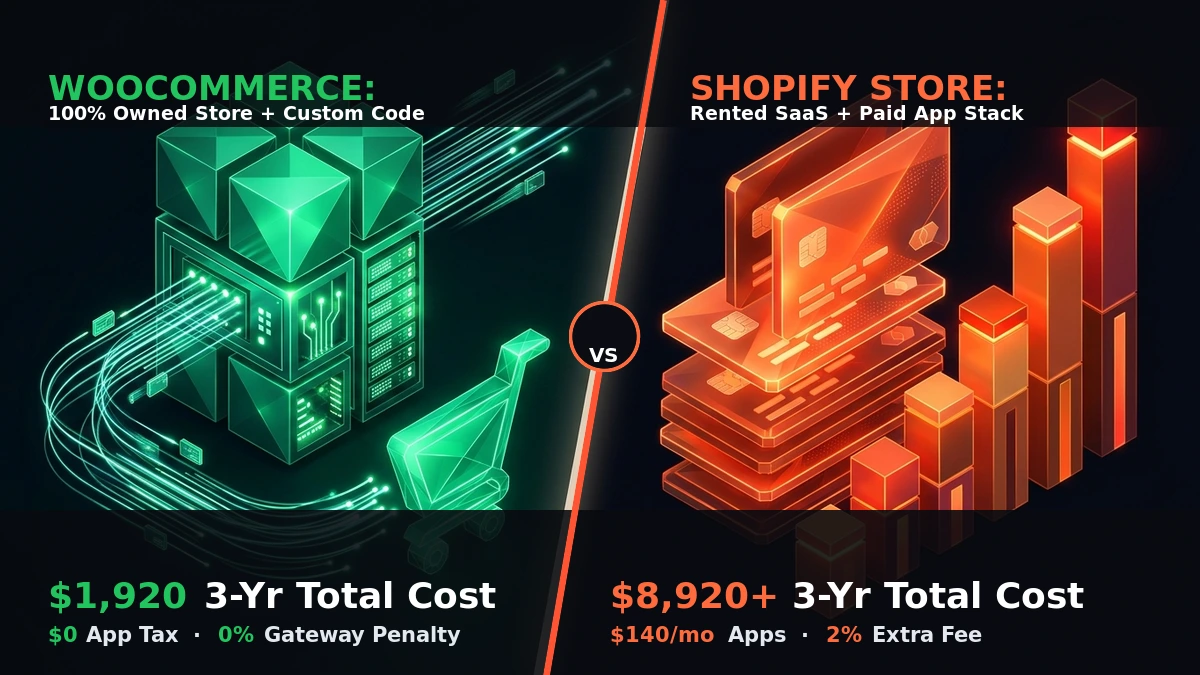
When calculating woocommerce vs shopify cost small business budgets over a 36-month period, a self-hosted WooCommerce store typically costs $1,920 to $3,400 total (including $18–$35/month cloud hosting, $0 core software fees, 0% platform transaction penalties, and a one-time $450–$2,500 custom build that you own 100%). A comparable Shopify store processing $10,000/month in sales typically costs $5,850 to $11,400+ over 36 months once you combine the $39–$105/month base plan, $85–$220/month in recurring third-party apps (filters, custom fields, subscriptions, SEO, reviews), a $350–$400 paid theme, and 0.5% to 2.0% extra transaction penalties if you use an external payment gateway.
Why the “$39/Month” Sticker Price Is the Wrong Way to Compare eCommerce Platforms
If you sell three t-shirts with zero product variations, no wholesale pricing tiers, no custom delivery rules, and no booking or RFQ requirements, Shopify’s entry plan works out of the box. The trouble starts the moment your small business needs the everyday merchandising features that real shoppers expect in 2026.
In my day-to-day work as a remote WooCommerce developer for US small businesses and UK online shop owners, founders rarely switch platforms because of the base $39 subscription. They switch because of three compounding cost traps that only appear after launch:
- The Monthly App Tax: On Shopify, features like multi-attribute product filtering, custom product tabs (dosage, technical specs, fabric care), wholesale B2B pricing tiers, advanced delivery date pickers, and subscription reorders usually require separate third-party apps from the Shopify App Store. Each app charges $15 to $49 per month—and many increase their monthly fee automatically as your order volume or SKU count grows.
- Double Payment Gateway Fees: Standard credit card processing via Stripe or PayPal costs roughly 2.9% + $0.30 per US card transaction. On self-hosted WooCommerce, you pay only your payment processor’s rate (0% extra markup from WooCommerce). On Shopify’s official pricing tiers, if you do not or cannot use Shopify Payments—which is common for businesses in the UAE, India, or specialized wellness and industrial categories—Shopify charges an additional 2.0% penalty fee on Basic, 1.0% on Grow, and 0.6% on Advanced on every single order.
- Rented Infrastructure vs. Owned Code: When you build on WooCommerce, the PHP templates, custom Gutenberg blocks, and MySQL database sit on your own hosting account. When you build on Shopify, you are renting access to a closed SaaS platform. If your seasonal business pauses for four months or you stop paying the monthly bill, your entire storefront disappears offline.
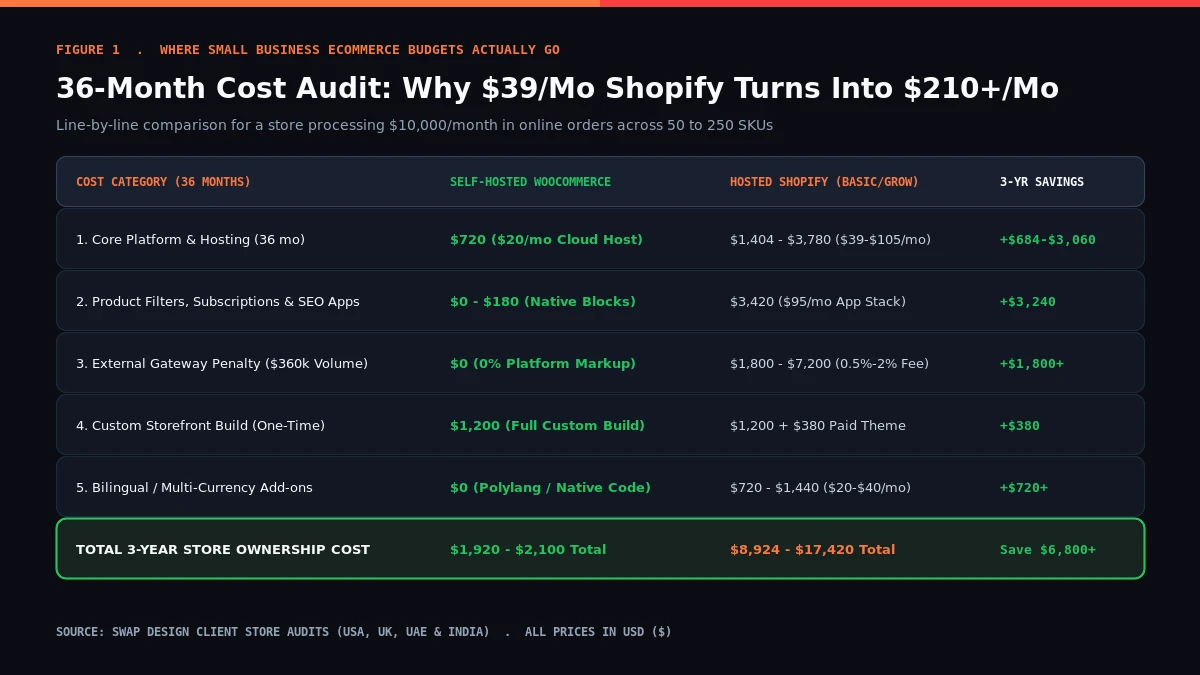
Line-by-Line Breakdown: WooCommerce vs. Shopify Cost for Small Business Over 36 Months
To make this comparison concrete, let’s look at a realistic small business scenario I see every month: an established brand or specialty retailer with 50 to 250 products generating $10,000/month in online sales ($120,000/year, or $360,000 over three years). Here is how every cost category stacks up in USD ($) over 36 months:
| Cost Category (36-Month Horizon) | Self-Hosted WooCommerce (WordPress) | Hosted Shopify Store (Basic / Grow) | 3-Year Cost Impact |
|---|---|---|---|
| 1. Core Platform & Cloud Hosting | $0 core software + $18–$35/mo Cloudways/SiteGround/Hostinger ($648–$1,260 / 3 yrs) | $39/mo (Basic) to $105/mo (Grow) subscription ($1,404–$3,780 / 3 yrs) | WooCommerce saves $756 to $2,520 on base hosting |
| 2. Domain Name & SSL Certificate | $12/yr Cloudflare/Namecheap domain + $0 Let’s Encrypt SSL ($36 / 3 yrs) | $14–$17/yr domain + included SSL ($45 / 3 yrs) | Identical (~$36–$45 over 3 yrs) |
| 3. Storefront Theme or Custom UI Build | $0 bloatware theme; $450–$1,100 (5-page starter shop) or $1,200–$2,500 (full custom Gutenberg + WooCommerce build) | $350–$400 paid Shopify theme license + $1,200–$2,500 Liquid template customization | WooCommerce saves $350–$400 on commercial theme licensing |
| 4. Essential Store Features & App Stack | $0–$15/mo (Custom product fields, symptom/spec tabs, B2B RFQ forms, and SEO built natively in PHP/Gutenberg) | $85–$220/mo across 6–8 paid apps (Search/Filter $29, Reviews $19, Subscriptions $29, Custom Fields $19, SEO/Redirects $19) = $3,060–$7,920 / 3 yrs | WooCommerce saves $2,520 to $7,380 over 36 months |
| 5. Standard Card Processing ($360k Vol) | ~2.9% + $0.30 via Stripe, Apple Pay, or PayPal (~$10,800 pass-through processor cost) | ~2.9% + $0.30 (Basic) or 2.7% + $0.30 (Grow) via Shopify Payments (~$10,400–$10,800 processor cost) | Roughly even if using Shopify Payments |
| 6. Third-Party Payment Gateway Penalty | $0 (0.0% platform penalty) regardless of whether you use Stripe, PayPal, Authorize.Net, Razorpay, or PayTabs | 2.0% extra fee on Basic ($7,200 on $360k sales) or 1.0% on Grow ($3,600 on $360k sales) when using non-Shopify gateways | WooCommerce saves $3,600 to $7,200 for external gateway users |
| 7. Bilingual (RTL) or Multi-Currency Setup | $0/mo recurring using native Polylang/WPML setup and currency switcher code | $20–$49/mo for multi-language translation limits or currency rounding apps ($720–$1,764 / 3 yrs) | WooCommerce saves $720+ for UAE/global stores |
| 36-Month Platform + App + Build Total (Excl. Base 2.9% Card Interchange) | $1,920 – $3,400 Total (100% Owned Code & Database) | $5,850 – $11,400+ Total (Up to $17,400+ if paying external gateway penalties) | Net 3-Year Savings: $3,930 to $8,000+ |
The Hidden Cost #1: Why Shopify’s “App Stack Creep” Quietly Doubles Your Monthly Bill
When a business owner reads a generic blog post about woocommerce vs shopify cost small business, the writer usually lists plugins and apps as “optional.” In real production stores, they are not optional—they are how your customers find products and complete orders.
Let’s look at what happens when you build a specialized store on Shopify versus how I engineer the exact same functionality on WooCommerce:
- Custom Product Specifications, Dosage Tables, or Technical PDFs: Suppose you sell herbal formulations, industrial parts, or custom apparel. Each product needs structured tabs for Ingredients / Material Grade, How to Use / Dimensions, and a downloadable PDF spec sheet. On Shopify, non-technical owners almost always install a paid page-builder or metafield tab app ($19 to $29/month). On WooCommerce, I register native custom fields and clean Gutenberg block templates once during the build. Your recurring monthly cost is $0 forever.
- Multi-Attribute Filtering (Filter by Health Concern, Collar Cut, or Industry): Default collection grids make mobile shoppers scroll endlessly. On Shopify, advanced filter and search bars quickly push you into a $29 to $59/month app tier once your catalog passes 100 SKUs. On WooCommerce, I build lightweight, indexed taxonomy filters directly into the theme template with zero monthly SaaS tax.
- Combined Service Booking + Product Checkout: Many small businesses are not pure-play box shippers; they sell both physical products and consultations, installations, or clinic appointments. On Shopify, bolting a calendar booking system onto a product store requires a $25 to $49/month booking app that rarely matches your brand UI. On WordPress + WooCommerce, combining service lead funnels, consultation scheduling, and retail product checkout is native to the platform.
- B2B Wholesale Tiers & Request-for-Quote (RFQ) Carts: If you sell both single units to retail buyers and bulk cartons to trade distributors, Shopify’s native B2B wholesale suite requires upgrading to Shopify Plus ($2,300/month)—or stacking two separate $39/month wholesale pricing and quote-cart apps. On WooCommerce, I configure role-based wholesale pricing and a “Request Bulk Quote via WhatsApp / Email” button for a one-time setup fee inside your standard $1,200–$2,500 build.
The Hidden Cost #2: Payment Gateway Penalties Across the USA, UK, UAE, and India
Payment processing is where small business margins get squeezed the hardest. Before choosing between WooCommerce and Shopify, you need to check whether Shopify Payments is supported for your country and product category:
- USA & UK Stores (Standard Retail): If you are registered in the US or UK and sell standard apparel or home goods, you can use Shopify Payments (which runs on Stripe behind the scenes) and avoid the extra 0.5%–2.0% platform penalty. However, if you sell wellness supplements, CBD/hemp-adjacent herbal products, or specialized B2B equipment that Shopify Payments flags under its restricted merchant list, you are forced onto a third-party gateway like Authorize.Net or Square—and Shopify immediately deducts an extra 1% to 2% of your gross revenue on top of your processor’s fee.
- UAE (Dubai, Abu Dhabi, Sharjah) & India Stores: Many merchants in the Gulf and India rely on regional gateways such as PayTabs, Telr, Network International, Checkout.com, or Razorpay alongside Cash on Delivery (COD) and direct WhatsApp ordering. On Shopify Basic, every dirham or dollar processed through an external gateway triggers the 2.0% third-party transaction fee. On a store doing $12,000/month in sales, that single penalty costs you $240 every month ($2,880/year) for nothing. On WooCommerce, you connect PayTabs, Telr, Stripe, PayPal, or Razorpay directly via official plugins with zero platform markup.
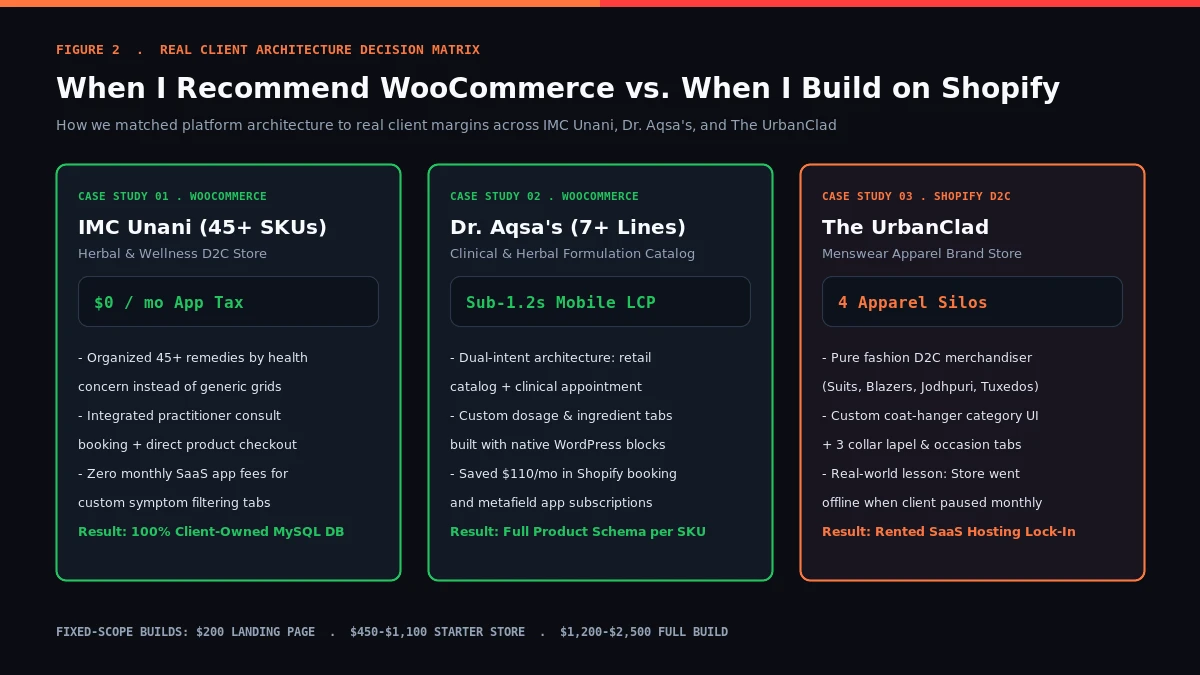
3 Real Client Stores I Built: Why We Chose WooCommerce vs. Shopify
I am not dogmatic about either platform—I build custom stores on both WooCommerce and Shopify depending on the founder’s business model. Here are three real client case studies from my portfolio that show exactly how woocommerce vs shopify cost small business math plays out in practice:
Case Study 1: IMC Unani (45+ Herbal Remedies + Practitioner Booking on WooCommerce)
When IMC Unani hired me to modernize their 85-year-old herbal wellness brand, they had 45+ Unani formulations spanning immunity, digestion, joint care, skin, and hair care—plus patients who needed to book a practitioner consultation before knowing which remedy to buy.
If we had built IMC Unani on Shopify, the client would have needed a $39/month base plan, a $29/month health-concern filter app, a $29/month clinic appointment booking app, and a $19/month custom ingredient metafield tab app—totaling $116/month ($1,392/year) in perpetual SaaS subscriptions plus external gateway penalties. Instead, I built a custom WordPress + WooCommerce storefront where shoppers filter 45+ remedies by health concern in one tap, inspect full dosage and herbal ingredient breakdowns, and either check out directly or book a consultation. Their recurring app tax is $0/month, and they own 100% of their MySQL customer and order database.
Case Study 2: Dr. Aqsa’s (Clinical Services + 7+ Product Lines on WooCommerce)
On Dr. Aqsa’s, the business combined two distinct revenue streams under one domain: clinical consultation services and a multi-category herbal product catalog across 7+ specialized formulation lines. Using clean WordPress Gutenberg blocks and lightweight WooCommerce templates, we engineered a fast mobile store (sub-1.2-second LCP) with complete Product and FAQPage JSON-LD schema markup for every item—saving roughly $1,300/year in recurring Shopify apps while ranking both clinical treatment pages and product pages under the same SEO authority.
Case Study 3: The UrbanClad (Custom Menswear D2C Store on Shopify — And a Real Ownership Lesson)
For The UrbanClad, a menswear manufacturer selling structured suits, formal blazers, wedding Jodhpuri sets, and tuxedos, we built a custom Shopify D2C storefront featuring an emerald-green and champagne-gold palette, custom coat-hanger category cards, interactive Business / Wedding / Regular occasion tabs, and collar lapel filters (Peak, Notch, and Shawl Lapel).
Shopify was a strong fit for their pure apparel merchandising flow during their active launch campaign. However, The UrbanClad also illustrates the biggest financial difference in the woocommerce vs shopify cost small business debate: when the client later decided to pause their recurring Shopify subscription, the live storefront went completely offline because Shopify locks your templates and store engine to active monthly billing. We preserved the full 1920×7263 design archive inside our case study, whereas a self-hosted WooCommerce store can be archived or moved to a $5/month holding server indefinitely while keeping every URL live on Google. (I cover this lock-in rule in detail in my guide on whether you truly own a website built on a hosted platform.)
What About Speed, Core Web Vitals, and SEO in 2026?
A common myth repeated by SaaS marketers is that “Shopify is always faster than WooCommerce.” After running WordPress & WooCommerce speed optimization audits on dozens of stores, I can tell you why that myth exists—and why it is backwards when both platforms are configured properly:
- Why DIY WooCommerce Stores Get Slow: Beginners buy a $59 multi-purpose ThemeForest theme packed with Elementor add-ons, Revolution Slider, and 40 unvetted plugins that load cart fragments and CSS on every single page. As I showed in my audit of 25 slow WordPress sites, those 7 plugin categories bloat mobile Largest Contentful Paint (LCP) to 5.2+ seconds.
- Why App-Heavy Shopify Stores Get Equally Slow: Every third-party Shopify app you install (reviews, popups, currency switchers, upsell drawers, chat widgets) injects external render-blocking JavaScript into your storefront header. Worse yet, because Shopify is a closed SaaS server, you cannot edit the server caching headers, strip third-party app scripts cleanly from non-product pages, or optimize the underlying database queries.
- How a Clean Custom WooCommerce Build Wins on Speed & SEO: When I build a custom WooCommerce store using native Gutenberg blocks, dequeuing unused WooCommerce cart scripts on informational pages, serving
1200×675WebP product images, and running Redis object caching on LiteSpeed or Cloudways, mobile pages load in 0.8 to 1.2 seconds with a 95+ Google PageSpeed score. Furthermore, WordPress gives you 100% control over URL permalink structures (no forced/collections/or/products/prefixes like Shopify), customProduct+MerchantReturnPolicy+FAQPageJSON-LD schema, and nativellms.txtfiles for AI search engines (see why WordPress wins for AI Search & AEO).
Fixed-Scope Development & Maintenance Cost: Agency vs. Direct Senior Developer
Whether you choose WooCommerce or Shopify, your upfront build cost depends on who writes the code. Traditional eCommerce agencies in New York, London, or Dubai routinely quote $6,000 to $15,000+ for a small business online store because you are paying for account managers, project coordinators, and office overhead.
When you work directly with me (Swapnil Patil), there are zero middlemen. Every wireframe, product template, payment gateway test, and speed check is executed by me personally under clear fixed-price USD ($) tiers, billed 50/50 via Wire Transfer or PayPal:
| Swap Design Store & Care Tier | Fixed USD Price | Turnaround | What Is Included in Your Deliverable Scope |
|---|---|---|---|
| Single Product / Campaign Landing Page | $200 | 4 to 6 business days | High-converting D2C product drop or lead funnel page, mobile-first layout, direct checkout or WhatsApp link, 90+ PageSpeed score. |
| Starter Online Shop / 5-Page Store Build | $450 – $1,100 | 2 to 3 weeks | Focused WooCommerce or Shopify storefront (up to 5 core templates + initial product catalog setup), Stripe/PayPal/regional gateway integration, Product Schema markup, and 30-day bug-fix warranty. |
| Full Small Business Custom Store Build | $1,200 – $2,500 | 3 to 4 weeks | Complete custom store (up to 12–15 custom pages/templates), custom category filters (by symptom, occasion, or technical spec), shipping & tax zones, 301 redirect migration from Shopify/Wix if switching, sub-1.2s mobile speed, and 60-day post-launch warranty. |
| Monthly Store Care & Staging Updates | $120 – $250 / mo | Ongoing weekly checks | Weekly staging-tested WooCommerce and payment gateway updates, daily encrypted offsite backups protecting order history, 24/7 checkout uptime monitoring, and reserved monthly developer hours (view maintenance packages). |
5-Minute Decision Checklist: Should Your Business Choose WooCommerce or Shopify?
Before you commit to a platform—or if you are thinking about migrating an expensive Shopify store over to self-hosted WordPress—use this practical rule of thumb from my client discovery calls (and compare it with my broader WordPress vs. Shopify vs. Wix comparison and 2026 WordPress website cost guide):
Choose Self-Hosted WooCommerce If:
- You want to keep $3,500 to $8,000+ in your pocket over 3 years by eliminating recurring $100+/month app stacks and platform gateway markups.
- You sell products alongside services, consultations, or B2B RFQs (like IMC Unani or Dr. Aqsa’s).
- You use regional payment gateways (PayTabs, Telr, Network International in the UAE; Razorpay in India; or specialized US/UK merchant accounts) and refuse to pay Shopify’s 1%–2% penalty fee.
- Organic Google Search & AI Search (AEO) are core acquisition channels, and you want clean URL slugs, custom JSON-LD schema, and high-authority blog content on the same domain.
- You require 100% legal and technical ownership of your PHP code, MySQL customer records, and hosting server.
Choose Hosted Shopify If:
- You run a pure-play D2C fashion or lifestyle drop brand that fits standard size/color variants without custom B2B quoting or booking flows.
- Your business qualifies for Shopify Payments in the USA or UK and needs fewer than 2 paid apps total.
- You use Shopify POS hardware across physical retail pop-up shops and want unified in-person barcode scanning out of the box.
- You are comfortable paying higher monthly SaaS overhead ($120–$300+/month in combined plan + app fees) in exchange for fully hosted server infrastructure, and accept that the site goes offline if billing stops.
Want an Honest Cost & Speed Audit of Your Current Store?
If you are currently paying too much in monthly Shopify app fees, struggling with a sluggish WooCommerce checkout, or planning a new online store in the USA, UK, UAE, or India, you do not need to guess which setup will cost less over the next three years. Send me your current store URL (or your product count and target country) via the Swap Design contact form or message me directly on WhatsApp. I reply personally within 1–2 hours with a plain-English breakdown of your 36-month platform costs, payment gateway fees, and a fixed-price quote in USD ($).